
“What flashlight?”
“WML or handheld?”
Your eyes are your main source for gathering
information. Your eyes do not work in the dark. You need a light source to see
in the dark. And in a defensive context you need to always identify your
target.
Let’s look at handheld flashlights first. You
should get one before you get a Weapon Mounted Light. If you can afford both,
awesome.
But remember the one does not replace the
other.
Now you get lots of options with handheld
flashlights…
First understand what you are looking for in a
flashlight.
What will the main use of the flashlight be?
Defensive, utility, everyday carry, bedside,
camping or spotting game?
Not all flashlights are designed for all
applications. The Nitecore P35I or Speras M4 are great for camping and the
outdoors but they are not great as everyday carry lights. The Nitecore NU11 is
an excellent utility light but it is not a great defensive light.
So
understand what you need from a flashlight before you just go plonk down bucks
on a flashy sale.
Let’s look at what I want from my defensive
flashlight.
The flashlight that I grab when something goes
bump at night. This is the flashlight that must always work. Yes I have lots of
other flashlights that do not meet these requirements but they are for other
applications like camping and fishing.
They are my toys; my defensive flashlight is
my workhorse, the one I depend my life on.
The switch and UI.
A good defensive flashlight must have a tail
switch; side switches do not work great with a gun in your hand.
It must be a rubber tail switch, with
momentary. The switch must have enough travel to allow momentary on without
going full on. Other types of switches do not give you the responsiveness of a
good rubber switch. The tail switch of the Speras EST is big and easy to use…even
with gloves.
If the tail switch also changes the modes of
the flashlight, it must be setup so that you do not change modes accidentally.
Try and test this if you plan on buying a model with only one button. A
flashlight that changes modes by just holding the button will not work.
And the strobe function….
It should be hidden away so well in the UI
that I can never get to it.
Strobes belong in discos and last I checked
disco was dead.
The switch must also be protected or be setup
so that it does not activate by accident in your pocket or go bag. Most
manufacturers sort this out by the simple addition of two U-Shaped extensions
on the tail cap body. A simple addition that solves a lot of problems.
If the flashlight has a separate button to
change modes like a side switch make sure that it can only be done with the
light being switched on with the tail switch. Side switches are easy to
activate in your pocket…you do not want to go for your defensive flashlight in
a life or death situation and it’s in moonlight mode.
And if you have to carry a flashlight in a
“lockout” mode, it is not a good choice for a defensive flashlight.
Lumens and Candela.
It must have a good balance of lumens and
candela.
You need enough lumens to provide you good
usable spill but you also need enough candela to give you that nice hot spot. A
higher candela rating will also give you more reach but more importantly will
allow you to defeat photonic barriers.
What is a photonic barrier? Shadows created by
other light sources or even your own flashlight. You will find a lot of
photonic barriers in any urban environment…even in your backyard. You need
candela to defeat a photonic barrier.
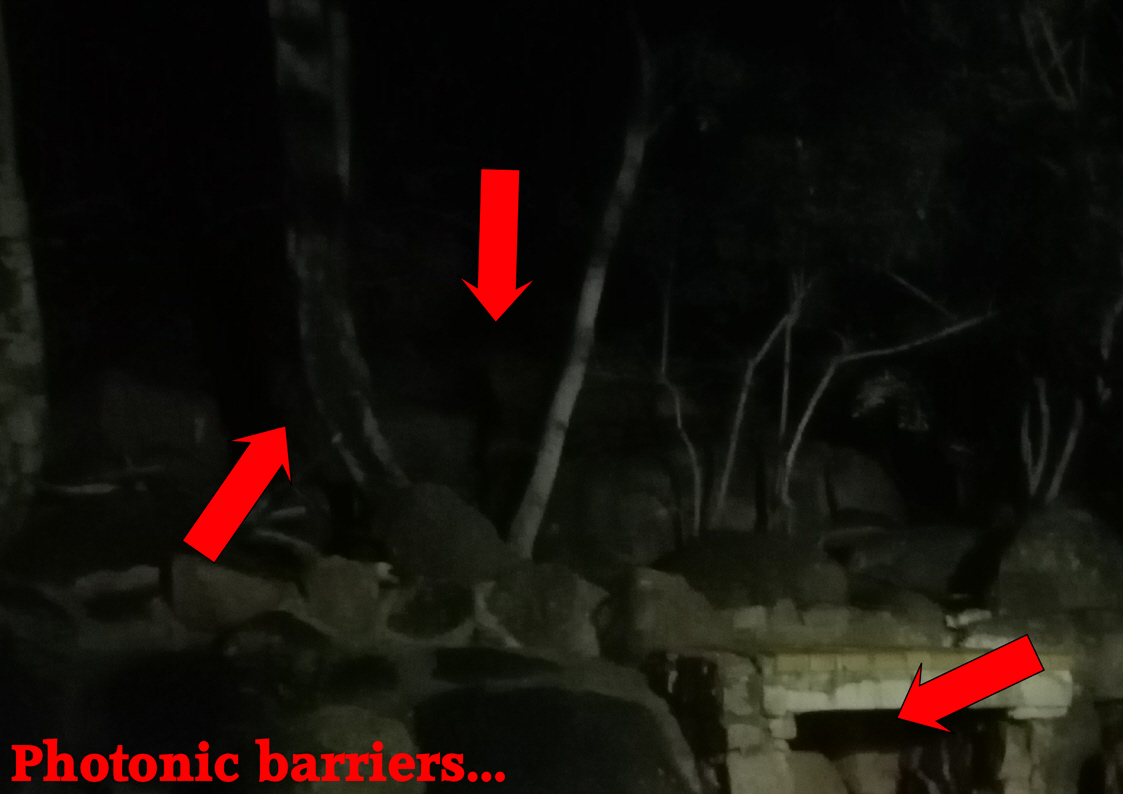
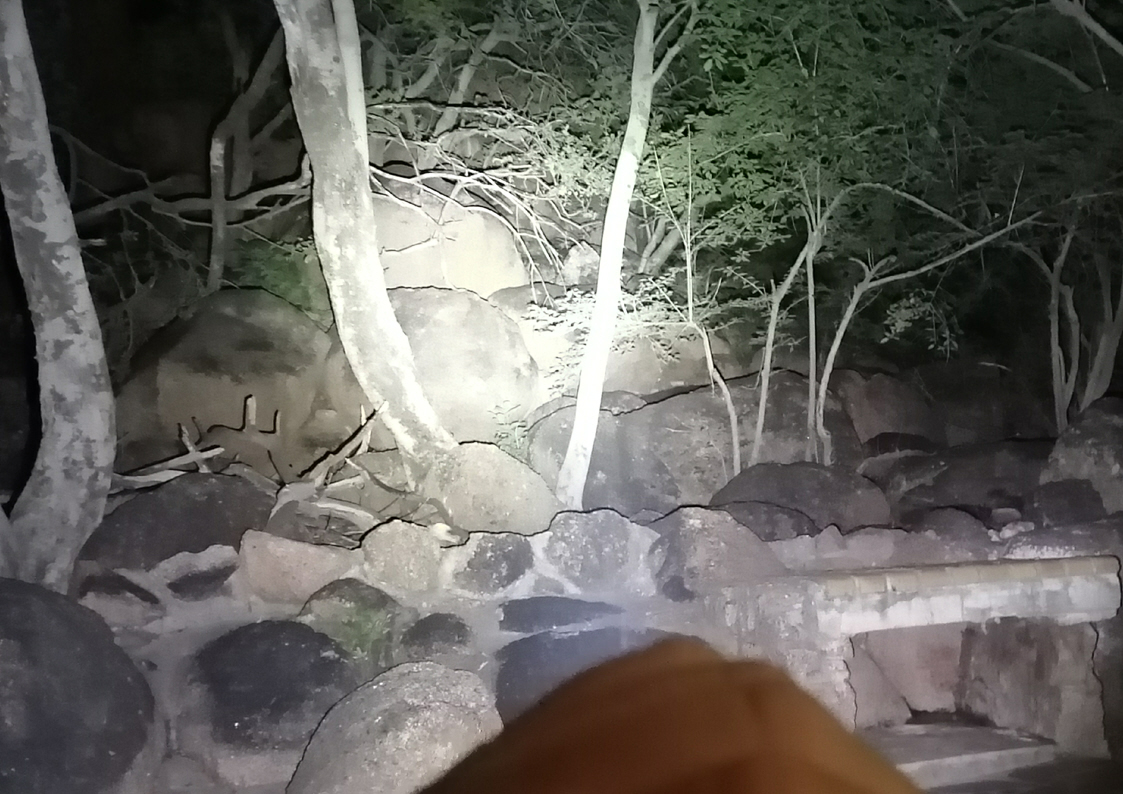
There is light in the first photo but look at the markers, these are photonic barriers.
In the second photo these barriers
are “defeated” by the flashlights candela.
So again you need a good balance of lumens and
candela.
Now you should also be careful when it comes
to the shape of the flashlight head…the reflector or business end of the light.
A small head with a lot of lumens is not a great idea. LED’s create heat and if
the head is small you run the risk of generating more heat than what any light
can handle. Top manufacturers have technology built in to protect against
overheating. But too much lumens in a
small head will always be a problem.
Batteries
I prefer my defensive flashlight to be dual or
triple fueled…in other words it must be able to run on more than one type of
battery.
Some manufactures have propriety
batteries…meaning you cannot use other batteries in their lights, they do this
by adding protection on the battery cell and make the battery too long to operate in other lights
or chargers…this also means that you cannot use standard batteries in their
lights.
This is something I am not a fan of. I want
the most options possible when it comes to batteries.
Batteries run flat. This usually happens at
the worst of times. So the ability to swop in a fresh battery quickly is very
important.
You also want to use a common battery that you can source spares of. 18650, 21700, 18350, 16340 and CR123A’s…and speaking of CR123A.
If the light can work with them also it is a
massive bonus…remember when I said double or triple fuelled…
CR123A’s will always be available and have
excellent shelve life.
So if the flashlight can also use CR123A’s you
will be good to go. Sure you might not get the same performance but you will
still have a functioning flashlight.
I also prefer to be able to charge my
batteries in a normal charger. Some manufactures batteries can only be charged
in the flashlight. This takes your light completely out of the fight…not ideal
for me.
And propriety charging cables is also a no for
me…think about it. What happens when you lose that charging cable? How will you
charge your flashlight? A simple USB or
USB C charging method works great. When you lose your charging cable you can
just use your cell phone charging cable.
And don’t be fooled, there are only a handful
of battery manufacturers in the world. Most flashlight companies buy their
cell’s from them and add their protection circuits or in some cases just wrap a
sticker around the battery.
Size matters
The light should also be the right size, just
big enough to run with a gun using one of the more favoured techniques like
Harries or better yet the Rogers techniques.
You also need some sort of retention device.
Guns run empty and can malfunction; you will need both hands to sort this out.
Dropping your light on the ground is not an option. Whether it’s a lanyard,
tactical grip ring, retention ring like the Thyrm Switchback or a piece of
bungee cord tied on the light (Kyle Lamb from Viking Tactical has a neat trick)
you need to retain your flashlight while doing mag changes or stoppage
clearances.
Made in China?
I would guestimate that 80% of the world’s
flashlights are made in China. I do not care where the light is made, as long
as it is a quality item and made by a reputable company to ANSI/PLATO FL 1 2019
or ANSI/NEMA FL 1-2009 Standards.
Go and readup about the 2 ANSI standards here.
Aircraft grade aluminum and military grade
HAIII hard-anodized are a must. IP67 or higher.
And a drop rating of at least 1 meter.
Standard stuff these days.
These are the requirements I have for my
defensive flashlight.
Now the next most important thing you can do
is go on a low light course. Learn about flashlights and how to apply them.
Then you can move onto a Weapon Mounted Light.
My requirements for a WML are…it must work,
always. When this light comes into play the shit has hit the fan.
My WML musts.
Batteries
I prefer CR123A’s or their rechargeable
brother the 16340. I need to be able to swop a dead battery quickly be able to
access the battery compartment without removing the light from the gun
Why CR123A’s? They have a long shelve life…you
can leave one in the light for a long time and it will work when you need it
to…There’s a reason why Surefire still run CR123A’s.
A built in battery is convenient but what
happens when it dies in the middle of a fight?
Holster
You need one. Can you get one? I want to be
able to carry my gun with the light on it all the time. So a good holster is a
must.
But now you will ask me, why carry your WML in
the day? And I will retort with, why do you carry a flashlight in the day? Our
country does not have a stable electrical grid…imagine you are in the mall
toilet and the lights go off…shit hitting the fan in the dark is worse than
shit hitting the fan in the light.
Mounting
My WML must be part and parcel of my carry
gun. And it must be secured properly. The old screw type securing method is
hard to beat.
Quick on and off rail mounts are convenient
but that’s one more moving part that can fail. Plus this idea of only attaching
the WML at night has two problems:
You can forget.
Unnecessary extra firearm handling…things tend
to go wrong.
Lumens
My WML must have enough lumens for when it
comes to play and most of the time it will be up close and personal. I prefer
more spill than a hot spot with my WML. Again, remember that your WML should
not be used as a search light. That’s your handheld’s job. It should also not
replace your sights. Yes I am looking at you Mr. Laser…you belong with Mr.
Strobe at the Disco…
Switches and UI
The switches must also be easy to use under
stress and must have a momentary function. They must be as simple as possible.
And be designed so that they do not switch on when holstering or worse when
drawing your gun.
Built Quality
ANSI/PLATO FL 1 2019 or ANSI/NEMA FL 1-2009
Standards is a must. A WML should be from a reputable manufacturer. Aircraft
grade aluminum and military grade HAIII hard-anodized are none negotiable, they
are a must. IP67 or higher. Drop rated to at least 1 meter.
These are my requirements for my defensive
flashlight and WML. Your requirements might differ but I hope this has helped
you make the right choice.
And remember:
Not all flashlights are made for all tasks.
Handheld flashlight for gathering
information…WML for the shooting. Do not mix the two.
Buy once, cry once.
Leave a Comment