
Note:
We will be looking at Pistol
reloading in these blogs…you can apply the same basics to rifle reloading but
you will need to do a bit more research…for example case trimming and which
press to get.
Read as much as you can about reloading.
Be it from Reloading Books like Richard Lee’s Modern
Reloading or from the internet. The more you know about reloading and
especially how your gun and bullet work the better it is for you. Knowledge
will only make the reloading process easier for you.
Check out our Blog Series about reloading 9mmp here, these
blog’s will give you a better understanding of what happens to cases when fired
and what we need to do to reload them.
In this series of Blog’s we will look at the
components and equipment needed for reloading.
So you just got your brand new gun and you have been
shooting it at the range. I hope you are collecting the cases…they are the
starting point of your reloading journey.
The most expensive component of reloading is your
case.
The fact that it can be reloaded again after firing is
the whole reason for starting your reloading journey.
A case can be reloaded multiple times.
Let’s look at the different types you can find.
The hated Berdan Primed case, these evil bastards are
to be avoided at all cost. If you look on the inside you will notice 2 small
flash holes. These cases cannot be reloaded by conventional means and they are
sure to damage your reloading equipment.
Steel cases cannot be reloaded. Luckily there is not a
lot of handgun ammo manufactures who use them. There are however a lot of rifle
ammo out there with steel cases.
The one you want to keep is the much loved Boxer
Primed Brass Case; these have just 1 flash hole and can be reloaded multiple
times.
There are other cases that are difficult to reload,
cases with crimped primers found on most ex-Military ammo. A good example of
this is S&B cases marked NX. Not only are these difficult to deprime but
their flash holes are also smaller.
You also get Nickel Plated cases, most Self Defense
Ammo have these cases. They are fine to reload but might not last as long as a
normal brass case.
Look out for cracked cases also, cases do not last
forever and will start cracking when they are done. Usually a crack will form
from the case mouth to the rim.
But you are more likely to lose a case before it
starts cracking.
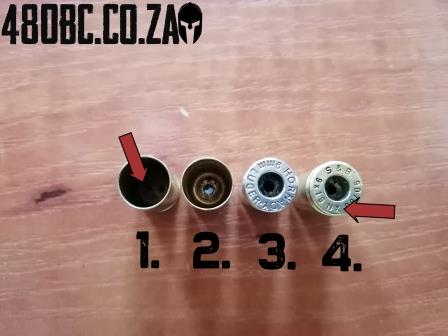
In this picture are 4 cases.
The hated Berdan Primed Case…note the 2 tiny flash
holes.
This is a Boxer Primed Case…the one you want to reload.
A Nickel Plated case, fine for reloading….as long as it is Boxer Primed.
The S&B NX case…keep these aside for now. They are difficult to
reload and require a bit of experience.
Ok, so now you have a few cases and you plan to start
reloading them. Let’s discuss the first step.
They are dirty and need a good cleaning before you can
reload them. Now there are various methods to get to clean cases. You must
decide which one of these will work for you.
Let’s start with the cheapest method.
Soaking your cases in a homemade brew of cleaning
goodness…yes you can clean most of the dirt off your cases with this simple
trick…however cheap usually comes with a drawback. Your cases will not be 100%
clean and they will not shine. But this is a very cheap and easy way to clean
the worst of your cases.
Take a 2 litre bottle with a mouth big enough to fit
your cases. Fill with water and then mix in the following: 1 teaspoon Citric
Acid, 1 Teaspoon Sunlight, 1 Teaspoon Vinegar. Mix well and add your cases.
Shake around for a bit, about 20 minutes. Remove your cases and rinse them
well.
Use Citric Acid not Tartaric Acid! Tartaric Acid is
hard on your cases and if you do not rinse them properly it will turn your
cases pink and make them brittle.
The next method is a Sonic Cleaner, they are quick and
easy to use. This will clean your cases well but will not leave you with shiny
cases. Sonic Cleaners are a good investment as they can clean other items. You
can also use the above mix in a Sonic Cleaner. I started with a Sonic Cleaner
years ago.
Then onto my preferred method; a dry tumbler.
This
uses a tumbling media like corn cob or nut shells to clean and polish your
cases. They are easy to use and affordable. The Lyman Turbo 1200 Pro is
affordable and does a great job. There is no water involved with dry tumbling
so you could reload directly after tumbling…the reason I prefer dry tumbling.
The dry tumbler with the right choice of media will give you shiny cases but
won’t clean the inside of the case. For
pistol reloading this is fine.
I use the Lyman 1200 Pro with their Tufnut media. I
also add a dash of liquid car polish to get the cases really shiny.
But the best way to clean your cases is a Wet Tumbler.
This uses a mix like the above with stainless steel pins. It cleans the cases
inside and out, even cleaning the primer pockets. But Wet Tumblers are
expensive and you have a drying period. There are many options on the market,
even building your own but if you want to process a lot of cases at once you
have to go with something like the Lyman Cyclone Wet Tumbler. This tumbler can
clean 1000 223 cases in one go.
If you are using any wet method you must let your
cases dry properly. Water and gun powder do not mix!
If Wet Tumbling or Sonic Cleaning is your choice then
consider getting the Lyman Cyclone Case Dryer. This will dry 1000 223 cases in
3 hours.
Ok, so now you know which cases to keep and you have a
few options on how to clean them.
Next we look at what type of Reloading Press you need.
Leave a Comment